A Virtual Company Enhancing People-to-People Communication

A Virtual Company Enhancing People-to-People Communication
As Melita International expanded its pioneering work in intelligent caller identification and customer communications during the 1980s, the company's innovations began attracting attention from across the telecommunications industry. Among those who took notice was inventor and entrepreneur Ronald A. Katz, whose later work in telecommunications patent licensing would make him one of the most recognizable figures in the field.
During this period, representatives for Katz challenged the validity of Aleksander Szlam's U.S. Patent No. 4,797,911, which described a method for identifying callers by retrieving customer information from external databases using Automatic Number Identification (ANI). The patent represented a significant advancement beyond traditional telephone number display by enabling businesses to identify customers and present relevant information to representatives before the call was answered.
According to Melita International's historical records, the discussions ultimately resulted in a negotiated resolution that included a cross-licensing agreement between the parties and a payment of $10,000 to Melita. The agreement allowed each party to continue developing technologies within their respective patent portfolios while avoiding further conflict over the intellectual property at issue.
Although the specific terms of the agreement remained confidential, the interaction demonstrated the commercial importance of Melita's inventions. Significant patents are frequently challenged, licensed, or cross-licensed when multiple innovators are working to solve similar technological problems within rapidly evolving industries.
In the years that followed, Ronald Katz became widely known for building an extensive telecommunications patent portfolio and licensing those patents throughout the telecommunications industry. His licensing activities and patent litigation against major communications companies became some of the most closely followed intellectual property cases of their era.
Viewed in historical context, the encounter between Melita International and Ronald Katz illustrates an important milestone in the evolution of modern customer communications. It reflects a period when innovations such as intelligent caller identification, predictive dialing, automated callback systems, and intelligent call routing were transforming the call center industry from simple telephone operations into sophisticated customer engagement platforms.
Today, the interaction serves as further evidence that Melita International's technology had become sufficiently important to attract the attention of other innovators working in the emerging field of intelligent telecommunications. Rather than defining Melita's legacy, the patent challenge underscores the broader influence of Aleksander Szlam's work during a formative period in the evolution of modern contact center technology.
FOLLOW THE RECORD
1987–1989 — Patent record
U.S. Patent 4,797,911, Customer Account Online Servicing System, names Aleksander Szlam, James Crooks Jr. and Curtis Marks. Its architecture integrates telephone processing with computerized customer information. US Patent and Trademark Search
1996 — USPTO interference
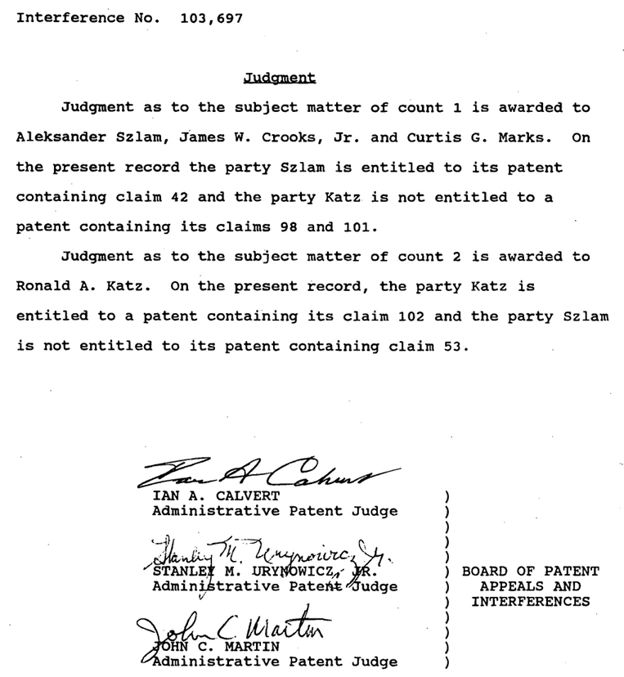
The USPTO interference documents show Szlam Claim 42 placed against Katz's competing claims.
November 1996 — BPAI Final Decision
The document says judgment on Count 1 was awarded to Szlam, Crooks and Marks, while Katz prevailed separately on Count 2.
February 1997 — USPTO Official Gazette
The USPTO published the adverse portion of that interference in its Official Gazette. It records Patent 4,797,911, identifies Szlam, Crooks and Marks, and records the November 20, 1996 adverse judgment concerning Claim 53. USPTO
That independently corroborates the Count 2 side of the BPAI decision.
2011 — Federal Circuit
Fifteen years later, Szlam technology turns up again in major Katz patent litigation.
The Federal Circuit expressly discusses Szlam as prior art, the use of ANI and caller-entered information to obtain account information, and what the court calls Szlam's "ANI-based identification process."
Several Katz claims remained invalid because Katz could not establish priority over the Szlam prior art or because the claims were obvious in light of Szlam combined with other prior art. Justia Law

U.S. Patent No. 4,797,911, Customer Account Online Servicing System, was issued January 10, 1989 from an application filed June 16, 1987. The Final Decision identifies that patent as the Szlam party's involved patent.
92026Szlam_Katz_Interference
The 1996 decision adds another layer to its historical significance.
It provides a contemporaneous federal patent record showing that:
Claim 42 became the subject of a formal USPTO patent interference.
The Board examined competing patent claims involving the underlying subject matter.
The Board considered whether Katz's earlier application supported the particular computer/telephone-number/customer-data relationship contained in Count 1.
The Board concluded it did not.
And ultimately:
That is not a retrospective claim made decades later.
It is part of the official patent record.